Best Solar Powered Chicken Coop Doors of 2026: A Comprehensive Review
For the modern homestead, the transition to solar-powered automation is a requisite for operational resilience, ensuring that the security of the flock.
Simone
5/4/20264 min read
Transparency Note: We use affiliate links on this page. If you decide to buy something through these links, we may earn a small commission. This helps us keep the site running and provides you with free content. Thank you for the support!
The evolution of the urban homestead has reached its logical conclusion: the total integration of biological systems with high-performance architecture. In 2026, we no longer view the backyard habitat as a peripheral hobby; it is a high-stakes node of decentralized food production. Central to this infrastructure is the Kinetic Portal—the autonomous entry system.
The chicken coop door, once a rudimentary mechanical slider, has been redesigned into a sophisticated piece of industrial security. It is the first line of defense in a "Zero Trust" biosecurity environment. For the modern homestead, the transition to solar-powered automation is a requisite for operational resilience, ensuring that the security of the avian flock is decoupled from the vulnerabilities of the centralized power grid.
This 2026 technical review analyzes the leading solar-powered autonomous entry systems through the lenses of precision engineering, material durability, and IoT-driven telemetry.
The Physics of Security: Actuation and Drive Systems
In 2026, the standard for structural integrity has moved beyond the simple "string-and-gravity" models of the previous decade. High-end architecture demands Active Actuation. We evaluate doors based on their resistance to external torque and their ability to operate under environmental stressors such as ice accretion or thermal expansion.
1. Worm-Gear Drive Architectures
The Smart Coop (the current industry benchmark) utilizes a precision-milled worm-gear drive. From a mechanical perspective, the worm gear is the superior choice for high-AOV structures because it is inherently self-locking. Once the motor ceases rotation, the gear geometry prevents any external force from prying the portal open. This provides a "deadbolt" level of security without the need for secondary manual latches.
2. High-Torque Brushless Motors
The transition to brushless DC (BLDC) motors in 2026 has significantly increased the lifecycle of these units. By eliminating friction-prone brushes, manufacturers like Run-Chicken have achieved a mean time between failures (MTBF) of over 15,000 cycles. These motors provide the necessary torque to clear debris or light snow from the threshold, ensuring the portal never fails in the half-open position—the most vulnerable state for any coop.
Solar Energy Harvesting: The 2026 Photovoltaic Standard
Energy independence is a cornerstone of the Modern Roost Lab philosophy. The latest generation of doors has moved beyond bulky, external panels toward Integrated Monocrystalline Thin-Film technology.
Advanced Battery Chemistry: LiFePO4 and Solid-State
The 2024–2025 transition to Lithium Iron Phosphate (LiFePO4) has now become the baseline. In 2026, we are seeing the first consumer-ready iterations of solid-state battery cells in premium models like the Smart Coop Ultra. These batteries offer:
Thermal Resilience: Operational stability from -30C to 60C.
Power Density: A single day of solar harvesting can power 45 days of operation in total darkness.
Longevity: A 10-year service life that matches the architectural lifespan of the coop itself.
The 2026 Tier-1 Analysis: Leading Systems
While the market remains saturated with entry-level plastic alternatives, the following systems represent the pinnacle of current avian engineering.
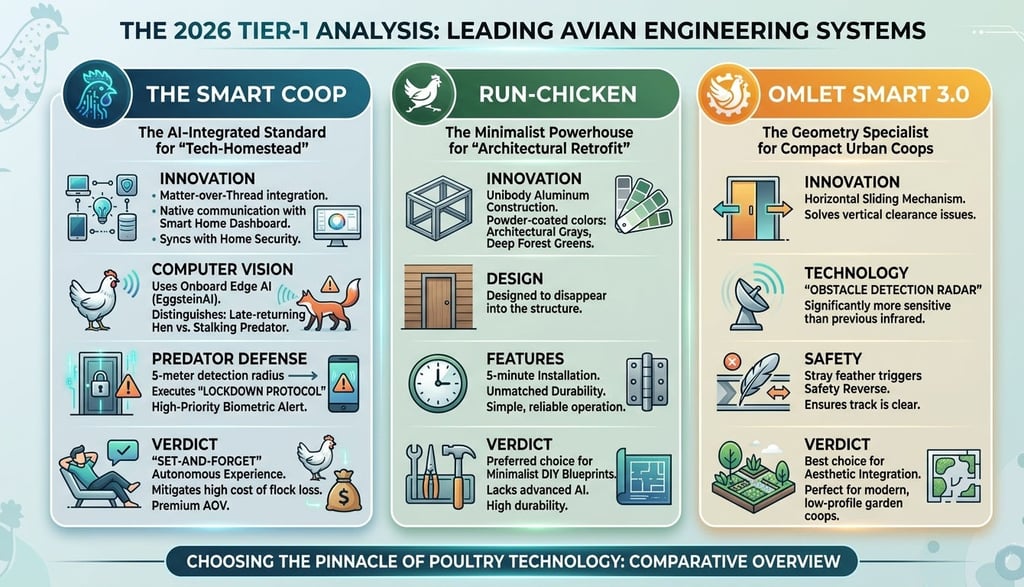
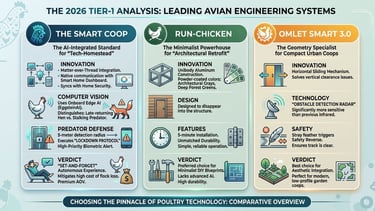
The Smart Coop: The AI-Integrated Standard
The Smart Coop remains the uncontested leader for the "Tech-Homestead" vertical.
The Innovation: Its 2026 update features Matter-over-Thread integration, allowing the coop door to communicate natively with your smart home dashboard. It doesn't just open and close; it syncs with your home’s security system.
Computer Vision: By utilizing onboard Edge AI (EggsteinAI), the portal can distinguish between a late-returning hen and a stalking predator. If a fox is detected within a 5-meter radius, the door executes a "Lockdown Protocol" and sends a high-priority biometric alert to your device.
The Verdict: For the modern homestead, this is the only system that offers a truly "set-and-forget" autonomous experience. It justifies its premium AOV by mitigating the high cost of flock loss.
Run-Chicken: The Minimalist Powerhouse
The Run-Chicken series continues to dominate the "Architectural Retrofit" market.
The Innovation: Its unibody aluminum construction is powder-coated in architectural grays and deep forest greens, designed to disappear into the structure.
The Verdict: While it lacks the Smart Coop's advanced AI, its sheer durability and 5-minute installation make it the preferred choice for minimalist DIY blueprints.
Omlet Smart 3.0: The Geometry Specialist
The Innovation: The 3.0 model features an "Obstacle Detection Radar" that is significantly more sensitive than previous infrared beams, ensuring that even a stray feather in the track will trigger a safety reverse.
The Verdict: The best choice for aesthetic integration in modern, low-profile garden coops.
Chicken Wellness through Data Telemetry
In the "Modern Roost Lab," we view the kinetic portal as a data-gathering node. A door is no longer just a door; it is a sensor that tracks the flock's Circadian Efficiency.
High-end systems now record:
Exit/Entry Latency: How long it takes for the flock to exit after the door opens. A sudden increase in latency is often the first clinical sign of sub-clinical illness or environmental stress.
Occupancy Verification: Using internal weight sensors and thermal imaging to ensure 100% occupancy before the final dusk lock-down.
This data-driven approach moves poultry management away from "guesswork" and into the realm of precision agriculture.
Future Outlook: The Biometric Frontier
As we look toward 2027 and beyond, the next frontier is Individual Avian Recognition. This will allow for the automated isolation of injured specimens or the implementation of "shift-based" grazing to protect the structural integrity of the surrounding pasture.
The autonomous, solar-powered portal is the heartbeat of the modern coop. By investing in precision-engineered hardware like The Smart Coop, the modern homesteader is not just buying a door; they are installing a sophisticated security administrator that ensures the longevity and productivity of their chicken specimens.