How to Build a High-Tech Chicken Coop: A Comprehensive Guide to IoT Integration.
The goal is total optimization: maximizing the wellness of your flock through data while maintaining a minimalist aesthetic that complements high-end residential design.
Simone
4/25/20264 min read
Transparency Note: We use affiliate links on this page. If you decide to buy something through these links, we may earn a small commission. This helps us keep the site running and provides you with free content. Thank you for the support!
The evolution of urban farming has reached a critical inflection point. We are moving away from the era of "backyard hobbies" and entering the age of the Modern Homestead—a decentralized, high-tech food production node integrated into the modern smart home. In this paradigm, the chicken coop is no longer a rudimentary wooden box; it is a precision-engineered environmental chamber.
To build a high-tech coop today is to engage in a multi-disciplinary exercise in architecture, material science, and Internet of Things (IoT) integration. The goal is total optimization: maximizing chicken wellness through data while maintaining a minimalist aesthetic that complements high-end residential design.
I. Structural Integrity and Material Science: The Chassis
Before a single sensor is installed, the physical structure must meet the standards of modern architectural performance. Conventional lumber is often insufficient for a high-tech build due to its susceptibility to thermal expansion and biological degradation.
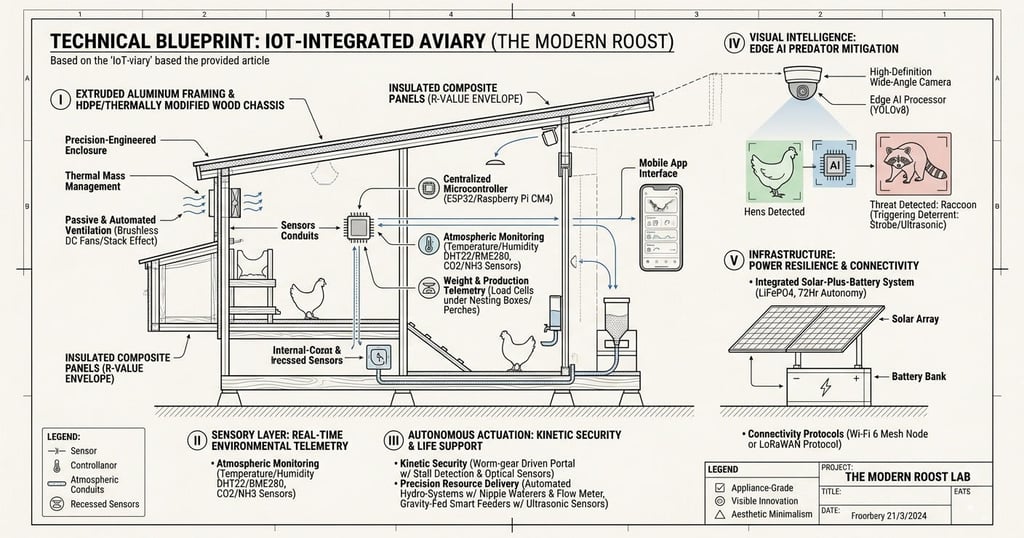
Precision-Engineered Enclosures
The "Modern Roost" utilizes a hybrid of extruded aluminum framing and high-density polyethylene (HDPE) or thermally modified wood (such as Thermory ash). These materials offer a near-infinite lifespan and provide a non-porous surface that prevents the colonization of red mites and pathogens.
From a technical standpoint, the chassis must account for:
Thermal Mass Management: Utilizing insulated composite panels with a high R-value to minimize energy expenditure for climate control.
Ventilation Dynamics: Implementing passive "stack effect" ventilation supplemented by automated, variable-speed brushless DC fans to maintain optimal air exchange rates (measured in Cubic Feet per Minute, or CFM).
II. The Sensory Layer: Real-Time Environmental Telemetry
The aspect of a modern coop begins with the sensory layer. Treat the interior of the coop as a controlled laboratory environment. By deploying an array of IoT sensors, we move from "observing" our flock to "analyzing" their biometrics.
1. Atmospheric Monitoring
A centralized microcontroller (such as an ESP32 or a Raspberry Pi Compute Module 4) acts as the nervous system, gathering data from:
DHT22/BME280 Sensors: For high-precision temperature and relative humidity tracking.
CO2 and Ammonia (NH3) Sensors: To monitor air quality. High ammonia levels are the leading cause of respiratory distress in poultry; automated alerts allow for immediate ventilation adjustments.
2. Weight and Production Telemetry
Integrating load cells under nesting boxes and perches allows for the collection of individual bird data. A sudden drop in a bird's "resting weight" or a change in their "nesting duration" are leading indicators of reproductive issues or illness, often detectable by AI models days before physical symptoms appear.
III. Autonomous Actuation: Kinetic Security and Life Support
Data is only valuable if it triggers an action. In an IoT-integrated coop, actuation systems handle the daily "labor" of poultry management with a level of precision no human can replicate.
Kinetic Security: The Smart Portal
The automatic door is the most critical point of failure in any coop. A high-tech build utilizes a worm-gear driven portal with stall-detection logic. Unlike gravity-based doors, these systems cannot be pried open by predators. Integration with a sunset/sunrise API ensures the door timing adjusts perfectly with the seasons, while "optical sensors" ensure no bird is trapped in the threshold.
Precision Resource Delivery
Automated Hydro-Systems: Low-pressure, nipple-based watering systems integrated with a flow meter can detect leaks or abnormal consumption patterns.
Gravity-Fed Smart Feeders: Utilizing ultrasonic distance sensors to monitor grain levels, sending "low-stock" notifications to the owner’s smartphone before the silo is empty.
IV. Visual Intelligence: Edge AI for Predator Mitigation
The frontier of coop technology lies in Computer Vision (CV). Passive security—fences and locks—is a "fail-safe" but not a "proactive" measure.
By deploying high-definition wide-angle cameras and running lightweight object detection models (such as YOLOv8) on edge devices, the Modern Roost can distinguish between a family dog, a resident hen, and a nocturnal threat like a raccoon or fox. When a threat is detected, the system can trigger a "deterrent protocol," such as activating high-intensity strobe lights or ultrasonic frequencies, while simultaneously pushing a high-priority alert to the user’s mobile device.
V. Infrastructure: Power Resilience and Connectivity Protocols
A high-tech coop is only as reliable as its uptime. For the modern homesteader, this requires a robust infrastructure strategy.
1. Power Redundancy
An integrated solar-plus-battery system (utilizing LiFePO4 chemistry for safety and longevity) ensures that life-critical systems—ventilation and security—remain operational during grid failures. The system should be sized to provide at least 72 hours of autonomy.
2. Connectivity: Wi-Fi 6 vs. LoRaWAN
For coops located near the main residence, a Wi-Fi 6 mesh node provides the bandwidth necessary for high-definition video streaming. However, for larger estates where the coop is situated at a distance, LoRaWAN (Long Range Wide Area Network) is the preferred protocol. It offers kilometers of range and penetrates architectural obstacles with minimal power consumption, making it ideal for transmitting sensor data.
VI. Aesthetic Minimalism: Designing for the Modern Estate
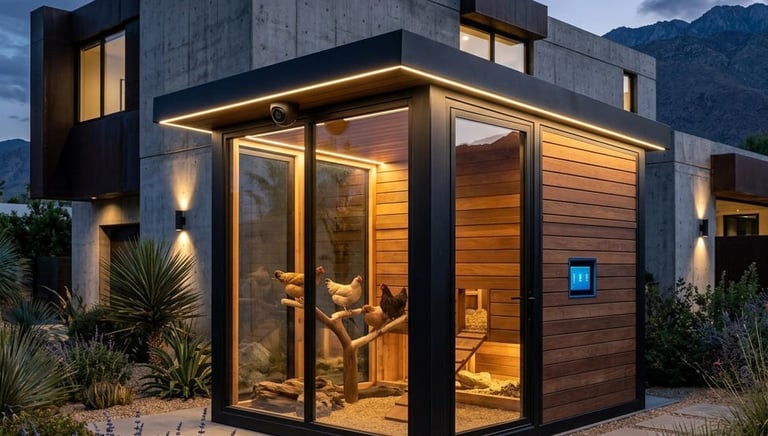
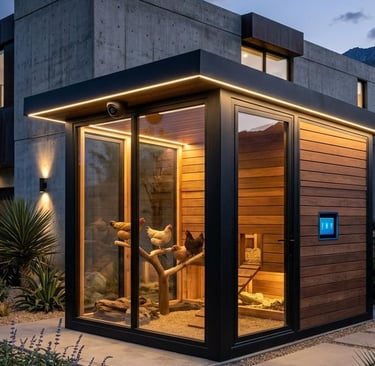
All this technology should be invisible. All wiring should be routed through internal conduits; sensors should be recessed; and microcontrollers should be housed in NEMA-rated, architecturally matched enclosures.
The goal is an "Appliance-Grade" finish. The coop should look like a natural extension of a contemporary home—using glass, steel, and clean geometric lines to signal that this is a site of innovation, not an afterthought of the backyard.
Future Outlook: The Autonomous Ecosystem
As we look forward, the integration of generative AI and machine learning will lead to the Fully Autonomous Aviary. We are moving toward a future where the coop manages its own micro-climate, identifies illnesses through acoustic "cough detection," and optimizes nutritional intake based on real-time egg production data.
Building a high-tech chicken coop is about more than just convenience. It is about applying the highest standards of human engineering to the natural world, creating a sustainable, resilient, and beautiful system that redefines the relationship between technology and the land.
And if it is too much of a struggle to build one, don't worry! Read our review on The Smart Coop, they have already built it.