
Insulated Coops vs. Heated Heaters: Which is Better for Winter Safety?
As we approach the winter solstice, the homesteader is faced with a fundamental engineering dilemma: should the focus reside on passive thermal regulation (insulation) or active caloric supplementation (heating)?
Simone
5/5/20264 min read
Transparency Note: We use affiliate links on this page. If you decide to buy something through these links, we may earn a small commission. This helps us keep the site running and provides you with free content. Thank you for the support!
The evolution of the urban homestead has necessitated a shift in how we perceive the biological management of poultry. In the modern era, the backyard coop is no longer a peripheral timber shed; it is a specialized environmental chamber designed to optimize the metabolic performance and safety of its inhabitants. As we approach the winter solstice, the homesteader is faced with a fundamental engineering dilemma: should the focus reside on passive thermal regulation (insulation) or active caloric supplementation (heating)?
For the homesteader, the answer lies in the physics of thermodynamics and the principles of precision architecture. While traditional methods often rely on the brute-force application of heat, the modern architectural approach prioritizes structural integrity and environmental control to ensure chicken wellness through data-backed design.
The Physics of Thermal Loss: Why Insulation is the Primary Directive
To understand winter safety, one must first understand the chicken biological unit. Chickens are high-metabolic organisms with a core body temperature of approximately 41 °C (106 °F). They are essentially self-powering heaters. In a poorly designed structure, this heat is lost through thermal bridging—the transfer of heat through conductive materials like uninsulated wood or thin metal.
The R-Value of Architecture
In high-end coop design, we measure success through the R-value (thermal resistance). A standard single-walled cedar coop offers negligible thermal resistance, forcing the birds to consume excess caloric energy simply to maintain stasis.
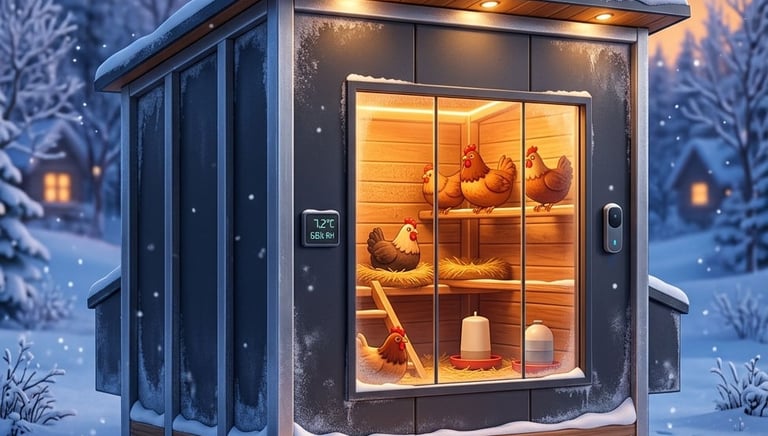
By contrast, an insulated structure—such as The Smart Coop—utilizes dual-walled, high-density polymer construction. This creates an "envelope" that traps the bird’s natural metabolic heat. When the structural envelope is optimized, the ambient temperature inside the coop remains significantly higher than the external environment without the need for a single watt of external power. This is the hallmark of precision engineering: achieving performance through design rather than consumption.
Material Science: High-Performance Solutions for the Modern Roost
Rejects the use of porous, low-performance materials. In the winter-resilient aviary, we utilize materials that offer both thermal stability and moisture resistance.
Expanded Polystyrene (EPS) and Closed-Cell Foam: When retrofitting architectural designs, these materials provide superior R-values per inch. However, they must be integrated into "sandwich panels" to prevent chicken pecking and maintain a minimalist aesthetic.
Thermally Modified Wood: For those prioritizing the "Modern Roost" aesthetic of cedar and oak, thermal modification alters the wood’s cellular structure, increasing its insulation properties and making it impervious to the rot caused by winter condensation.
High-Density Polyethylene (HDPE): The material of choice for The Smart Coop. HDPE is non-porous and can be molded with internal air gaps that act as natural thermal breaks, providing a maintenance-free, sterile, and warm environment.
The Volatility of Active Heating: Risks of Fire and Metabolic Stress
Active heating—specifically the use of heat lamps or space heaters—is often viewed as a failure of architecture. From a technical standpoint, adding a high-wattage heat source to a structure containing flammable bedding (straw or wood shavings) and high-activity animals is a significant risk-management oversight.
1. The Fire Variable
Dust accumulation on heating elements is a primary cause of coop fires. In a high-tech homestead, we aim for "Zero-Failure" systems. Traditional heat lamps are inherently high-risk and offer no precision control.
2. The Power Dependency Trap
Relying on active heating creates a dangerous dependency. If the grid fails during a localized winter storm, a flock that has become "softened" by a heated environment will lack the metabolic acclimation necessary to survive a sudden 20° drop in temperature. Passive insulation ensures that the flock’s natural down-feather insulation remains the primary—and most reliable—defense.
3. Metabolic De-optimization
Constant artificial heat can interfere with natural circadian rhythms and molting cycles. True chicken wellness is achieved by allowing the birds to adapt to the season within a structure that mitigates the extremes of wind and moisture, rather than negating the season entirely.
Psychrometrics and Ventilation: Managing the Moisture-Heat Paradox
The silent killer in winter is not the cold; it is moisture. A single chicken exhales a significant amount of water vapor and produces nitrogen-rich waste. In a sealed, insulated coop, this leads to a rise in relative humidity. If the humidity exceeds 70%, the moisture settles on the birds' combs and wattles, leading to frostbite as the water freezes.
The Integrated Ventilation Strategy
High-end architecture solves this through ventilation dynamics. A "Top-Down" air exchange:
Passive Clerestory Vents: Positioned above the roosting line to allow warm, moist air (which rises) to escape without creating a draft on the birds.
Automated Fan Systems: In a Modern Coop setup, IoT sensors—integrated with systems like EggsteinAI—can trigger ultra-low-power brushless fans when humidity levels cross a specific threshold. This ensures the air remains dry and oxygen-rich without compromising the thermal envelope.
Precision Monitoring: Avian Wellness through Environmental Telemetry
The distinction between a "farm" and a "lab" is the presence of data. For the winter-safe homestead, we move beyond guessing.
Utilizing an IoT Environmental Sensor Suite, the innovator monitors:
Delta-T: The difference between internal and external temperatures. A high-performing insulated coop should maintain a consistent positive Delta-T.
Humidity Index: Real-time tracking to ensure the "frostbite zone" is never reached.
Thermal Imaging: Using edge-AI cameras to monitor flock clustering. If birds are excessively "piled," it indicates a failure in the thermal envelope, allowing the owner to intervene before stress-induced illness occurs.
The Architect’s Verdict: Why The Smart Coop Redefines Winter Safety
For those who value the synthesis of form and function, The Smart Coop represents the pinnacle of winter-ready architecture. By prioritizing a precision-molded, dual-walled insulated chassis, it eliminates the need for high-risk active heaters.
It is a testament to the "Modern Roost" philosophy: the best technology is often invisible. The insulation is built into the skin of the structure; the ventilation is mathematically calculated to balance heat retention with moisture expulsion. When you invest in a premium structure, you are not just buying a shelter; you are buying an autonomous life-support system that operates with 100% uptime, regardless of the power grid.
Future Outlook: Self-Regulating Bio-Enclosures
As we look toward the 2027 horizon, the next evolution in coop technology will be Phase Change Materials (PCMs) integrated into the coop walls. These materials will absorb excess heat during the day and release it at night as the temperature drops, creating a perfectly flat thermal curve.
The winter-safe coop of the future is not a heated box; it is a smart, responsive membrane. By choosing insulation and data over heaters and luck, the modern homesteader ensures that their flock remains a high-performing, resilient asset of the autonomous homestead.