
Why Ammonia Sensors are the Most Important Safety Feature in Modern Coops
In the 2026 landscape of automated homesteading, real-time atmospheric monitoring is the definitive line between a thriving chicken unit and a compromised biological environment.
Simone
5/6/20264 min read
Transparency Note: We use affiliate links on this page. If you decide to buy something through these links, we may earn a small commission. This helps us keep the site running and provides you with free content. Thank you for the support!
The evolution of urban farming has transitioned from a rustic, manual pursuit into a high-stakes discipline of precision agriculture. As we integrate biological production nodes into the modern residential estate, the "chicken coop" has undergone a radical architectural transformation. It is no longer a peripheral timber shed; it is a specialized environmental chamber—a "Modern Roost Lab."
In this pursuit of optimization, the homesteader prioritizes the variables that define structural and biological success. While much attention is paid to predator-proof kinetic portals and aesthetic minimalism, the most critical safety feature in a high-performance aviary is invisible: Ammonia (NH3) telemetry. In the 2026 landscape of automated homesteading, real-time atmospheric monitoring is the definitive line between a thriving chicken unit and a compromised biological environment.
The Invisible Threat: The Biochemistry of Respiratory Vulnerability
Ammonia is a colorless, alkaline gas produced by the microbial decomposition of uric acid in poultry manure. In a poorly ventilated or inadequately managed structural envelope, NH3 concentrations can escalate rapidly, particularly in high-density or winter-sealed environments.
For the modern homesteader, understanding the physiological impact of Ammonia is a matter of chicken wellness through data. Unlike humans, who can detect ammonia by smell at roughly 20–50 parts per million (PPM), avian respiratory systems are compromised long before the human handler notices an odor.
The Ciliary Paralysis Variable
The primary defense mechanism of a poultry unit’s respiratory tract is the cilia—microscopic, hair-like structures that move mucus and trapped pathogens out of the trachea. Exposure to even moderate levels of ammonia (above 15 PPM) causes ciliary stasis. When these structures are paralyzed, the bird’s primary defense against airborne viruses and bacteria (such as Mycoplasma or Newcastle disease) is effectively neutralized. By the time the air "smells like a farm," the structural safety of the biological assets has already been breached.
Technical Specifications: The Engineering of Ammonia Sensors
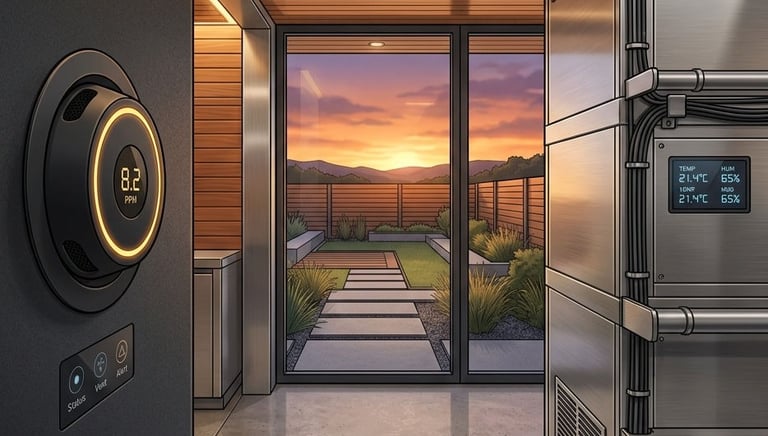
In a high-tech homestead, we move beyond "best guesses" toward precision engineering. An ammonia sensor in a Modern Coop is a specialized piece of hardware designed to operate in high-humidity, high-dust environments.
1. Electrochemical vs. Semiconductor Sensors
Modern systems utilize electrochemical sensors for their high selectivity and accuracy at low PPM levels. These sensors work by allowing ammonia gas to diffuse through a membrane where it undergoes a chemical reaction, producing an electric current proportional to the gas concentration. This data is then fed into a centralized microcontroller—the "brain" of the coop.
2. The Calibration Standard
Precision requires maintenance. In an architectural setting, these sensors are often housed in NEMA-rated enclosures with replaceable filters to prevent dust ingress. Innovators utilize systems that allow for "Over-the-Air" (OTA) calibration adjustments, ensuring that the sensor’s baseline remains accurate over years of operation.
Closing the Loop: Automated Mitigation and Ventilation Dynamics
Data without actuation is merely an observation. The true power of ammonia sensors lies in their integration with the coop’s kinetic and ventilation systems. We call this Closed-Loop Atmospheric Management.
Demand-Controlled Ventilation (DCV)
Rather than running fans on a static timer—which wastes energy and can negatively impact the coop's thermal envelope—an integrated NH3 sensor triggers Variable Frequency Drive (VFD) fans.
Tier 1 Response: At 10 PPM, the system increases passive airflow by adjusting automated clerestory louvers.
Tier 2 Response: At 20 PPM, high-efficiency brushless DC fans are activated to exchange the entire volume of air within the structure in under 120 seconds.
Tier 3 Response: If levels exceed 25 PPM, a high-priority alert is pushed to the user’s mobile dashboard (e.g., via the EggsteinAI ecosystem), signaling a potential failure in the waste management protocol or a moisture leak.
This precision-engineered approach ensures that the environment remains optimized for avian metabolic performance while preserving the structural integrity of the interior materials.
Materiality and Maintenance: Designing for Zero-Buildup
The architecture influences biochemistry. The materials chosen for a high-end coop directly impact the rate of ammonia production.
The Problem with Porous Surfaces
Conventional wood is a biological liability. It absorbs moisture and traps nitrogenous waste within its fibers, creating a permanent reservoir for microbial activity. Even with high-end cedar, the "ammonia floor"—the minimum level of gas present—remains higher than in engineered structures.
The HDPE and Stainless Steel Paradigm
High-performance structures, such as The Smart Coop, utilize non-porous materials like high-density polyethylene (HDPE) and medical-grade stainless steel. These materials allow for a "Zero-Retention" environment. When integrated with a sensor-driven maintenance schedule, these surfaces can be sterilized with minimal effort, ensuring that the primary source of NH3 is eliminated before it can aerosolize.
Chicken Wellness through Data: The ROI of Atmospheric Monitoring
In a high-AOV (Average Order Value) niche, where premium coops range from $1,000 to $7,000, the inclusion of a $200 ammonia sensor suite offers an unparalleled return on investment.
Feed Conversion Efficiency: Birds residing in a low-ammonia environment (<10 PPM) exhibit better feed conversion and higher egg production. Respiratory stress consumes caloric energy that should be directed toward production.
Loss Mitigation: By identifying atmospheric spikes early, the homesteader prevents the catastrophic "silent" respiratory infections that can wipe out a high-value flock.
Labor Optimization: Instead of performing manual "sniff tests" and premature bedding changes, the homesteader only intervenes when the data dictates. This is the definition of the modern, "hands-off" homestead.
Future Outlook: Predictive Atmospheric Management
As we look toward 2027, the next frontier in avian architecture is Predictive Analytics. We are currently moving from reactive systems—those that respond when ammonia is detected—to predictive models.
By cross-referencing internal humidity, ambient temperature, and avian occupancy data, AI-driven platforms like EggsteinAI will be able to predict an ammonia spike before it occurs. The system will preemptively adjust ventilation louvers and air-exchange rates based on forecasted weather patterns and historical biological output.
The "Modern Roost" of the future is a sentient structure. It understands the relationship between biochemistry and architecture, ensuring that the air within its walls is as pure as the design of its exterior. Ammonia sensors are not just a safety feature; they are the fundamental sensory organs of a truly smart aviary.