How to Install a Steel Worm Drive Door for Maximum Winter Reliability
The standard gravity-fed or string-pulley door is a legacy failure point, particularly in high-latitude environments. The solution for the 2026 winter cycle is the Steel Worm Drive System.
Simone
5/11/20264 min read
Transparency Note: We use affiliate links on this page. If you decide to buy something through these links, we may earn a small commission. This helps us keep the site running and provides you with free content. Thank you for the support!
The trajectory of the modern homestead has diverged sharply from its rustic origins. In this era, the pursuit of self-sufficiency is no longer a pastoral escape but a rigorous exercise in distributed agriculture and architectural optimization. In this high-performance environmental chamber, every component must meet industrial standards.
Nowhere is this demand for precision more critical than at the primary entry point: the kinetic portal. For the homesteader, the standard gravity-fed or string-pulley door is a legacy failure point, particularly in high-latitude environments. The solution for the winter cycles is the Steel Worm Drive System. This article outlines the technical installation and engineering rationale for integrating a worm-gear portal to ensure maximum operational uptime during catastrophic freeze events.
The Mechanical Advantage: Why Worm Gear Geometry?
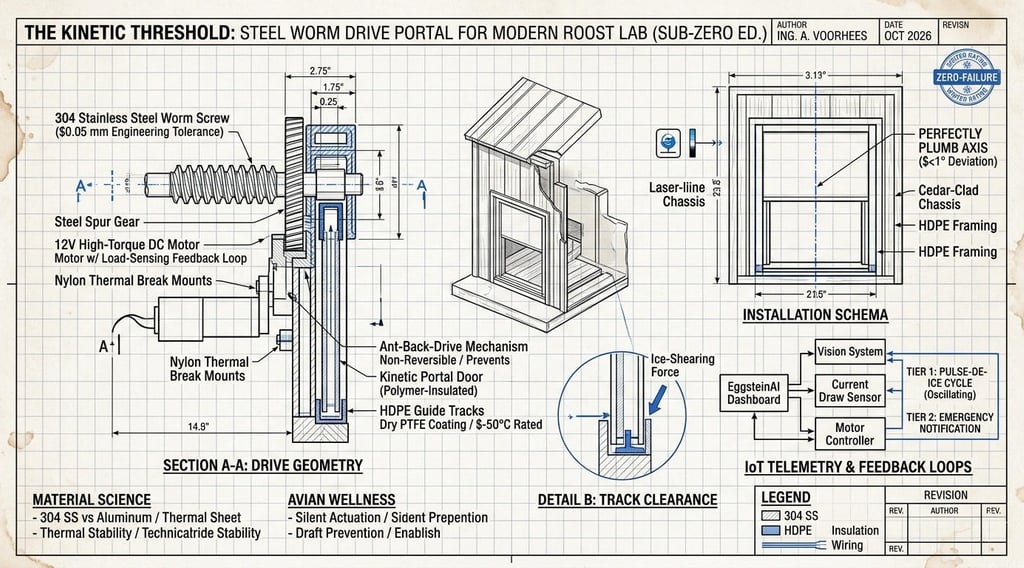
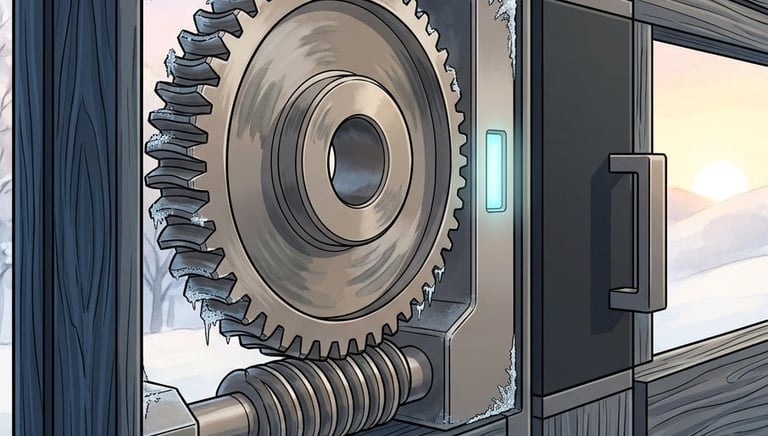
In the discipline of structural security, we categorize entry systems by their resistance to external torque. Traditional sliding doors are passive; they rely on weight or simple friction. In contrast, a worm gear drive—consisting of a threaded "worm" screw that engages with a circular "spur" gear—is an inherently non-reversible mechanism.
From a security standpoint, the geometry of the worm drive means the door cannot be back-driven by an external upward force. Whether challenged by a 33-pound raccoon or the high-pressure heaving of frozen ground, the door remains a static, unyielding barrier. This is not merely a feature; it is a mandatory fail-safe that protects the structural and biological equity of the flock.
The Torque-to-Friction Ratio
In sub-zero conditions, moisture within the guide tracks undergoes a phase change, transitioning from a lubricant to an adhesive (ice). A standard 12V motor with a string-lift fails when the "ice-bond" exceeds the motor's pulling capacity. A steel worm drive, however, converts high-speed, low-torque motor rotation into low-speed, extreme-torque linear force. This mechanical advantage allows the portal to shear through ice buildup that would render a standard door inoperable.
Material Science: 304 Stainless Steel vs. Aluminum
The material selection is dictated by the coefficient of thermal expansion and corrosion resistance. Use 304-grade stainless steel for all drive components.
Corrosion Resistance: The high-ammonia NH_3 environment inherent to poultry science is highly corrosive to lower-grade metals and untreated aluminum. Stainless steel maintains its structural integrity without the need for toxic coatings.
Thermal Stability: Aluminum has a high coefficient of thermal expansion, which can lead to "track-binding" when temperatures shift rapidly. Stainless steel offers a more stable profile, ensuring that the tolerances between the worm screw and the spur gear remain within the 0.05mm engineering limit required for smooth actuation.
Precision Installation: The Protocol for High-Performance Entry
To achieve a "Zero-Failure" winter rating, the installation of a worm drive door must be treated with the same precision as a residential HVAC integration.
1. Structural Plane Alignment
The primary cause of motor strain is "skew." Even a 1° deviation from the vertical plane can create lateral friction on the worm screw. We recommend utilizing a laser level to establish a perfectly plumb axis on the coop’s HDPE or cedar-clad chassis. The portal frame must be decoupled from the siding to prevent "seasonal shifting" from warping the tracks.
2. Thermal Break Integration
To prevent the "cold-bridge" effect, where exterior frost travels through the metal frame into the interior of the roost, the worm drive housing should be mounted using nylon or rubber thermal breaks. This ensures the internal electronics and gear lubrication remain at a more stable temperature than the external environment, preventing "cold-start" motor stalls.
3. Lubrication Calibration: The PTFE Standard
Traditional grease is discarded. Petroleum-based lubricants increase in viscosity as temperatures drop, eventually becoming a thick paste that inhibits motion. Instead, we utilize a dry PTFE (Polytetrafluoroethylene) coating. This provides a low-friction surface that does not attract dust or feathers and remains slick at temperatures as low as 122° F.
IoT Integration and Predictive Telemetry
A high-tech coop is defined by its ability to provide real-time status updates. The worm drive portal should be integrated into a centralized IoT Dashboard (such as the EggsteinAI or Smart Coop ecosystem).
Load-Sensing Feedback Loops
Modern controllers can monitor the "current draw" of the motor during the kinetic cycle. By establishing a baseline for energy consumption, the system can detect a "High-Resistance Event"—such as ice in the track or a bird in the threshold—before the motor suffers thermal damage.
Tier 1 Response: The system detects resistance and initiates a "pulse-de-ice" cycle, oscillating the door to break the ice bond.
Tier 2 Response: If resistance persists, an emergency push notification is sent to the owner's mobile device, accompanied by a high-definition image from the internal vision system to verify the obstruction.
Chicken Wellness: Beyond the Mechanics
While the focus of this audit is engineering, the ultimate beneficiary is the biological unit. A door that fails to close in a blizzard represents more than a mechanical error; it is a catastrophic breach for the chicken's wellness. By maintaining a constant, sealed environment, the worm drive portal prevents the "thermal-drain" associated with drafts.
Furthermore, the "Silent Actuation" of a precision-geared worm drive (operating at roughly 45dB) prevents the acoustic startle reflex in the birds, which has been linked to cortisol spikes and a subsequent drop in egg production. Optimization of the environment leads directly to an optimization of production.
Future Outlook: Biometric Recognition and Kinetic Autonomy
As we look toward the 2027 horizon, the evolution of the kinetic portal will move toward Total Autonomy. Utilizing edge-AI cameras, the door will only open for authorized residents, effectively barring "wild-vector" birds (such as sparrows or pigeons) that carry avian influenza, while the steel worm drive continues to provide an impenetrable physical barrier against nocturnal predators.
The installation of a steel worm drive is the definitive choice for the homesteader who views their estate as a pinnacle of innovation and safety.