
Managing Ammonia in a High-Tech Coop: Sensor Alerts and Remediation
Managing air quality is not a matter of "sniff tests" or manual labor. It is a challenge of atmospheric intelligence—utilizing advanced telemetry, superior material science, and automated remediation to ensure the structural and biological integrity of the homestead.
Simone
5/8/20264 min read
Transparency Note: We use affiliate links on this page. If you decide to buy something through these links, we may earn a small commission. This helps us keep the site running and provides you with free content. Thank you for the support!
The evolution of urban farming has transcended the rustic aesthetic of the 20th century. Today, localized food production is a discipline of high-performance architecture and precision biological management. As the "Modern Roost Lab" becomes a staple of the sophisticated residential estate, we must treat the environment within these structures with the same rigor as a clinical laboratory. In this high-stakes ecosystem, the most significant threat to avian wellness is not a visible predator, but an invisible chemical byproduct: Ammonia (NH3).
For the modern homesteader, managing air quality is not a matter of "sniff tests" or manual labor. It is a challenge of atmospheric intelligence—utilizing advanced telemetry, superior material science, and automated remediation to ensure the structural and biological integrity of the homestead.
The Invisible Variable: The Biochemistry of Ammonia Toxicity
To engineer a solution, one must first understand the chemical adversary. Ammonia is an alkaline gas produced by the microbial decomposition of uric acid found in poultry manure. This reaction is catalyzed by moisture and temperature, making the coop’s microclimate a primary driver of gas concentration.
In a traditional, low-tech coop, ammonia is often ignored until it reaches the human olfactory threshold—roughly 20 to 30 parts per million (ppm). However, in the discipline of poultry science, this is considered a failure of the environment. Chicken respiratory systems are highly specialized and exceptionally delicate. Exposure to as little as 10 ppm of NH3 over a prolonged period can lead to ciliary paralysis—the freezing of the microscopic hair-like structures that clear pathogens from the trachea.
When ciliary function is compromised, the "biological assets" (the flock) become susceptible to secondary infections, reduced metabolic efficiency, and localized inflammation. For the innovator, the goal is not merely survival, but the optimization of chicken performance through a "Zero-Trend" ammonia policy.
Precision Detection: The Engineering of Gas-Phase Sensors
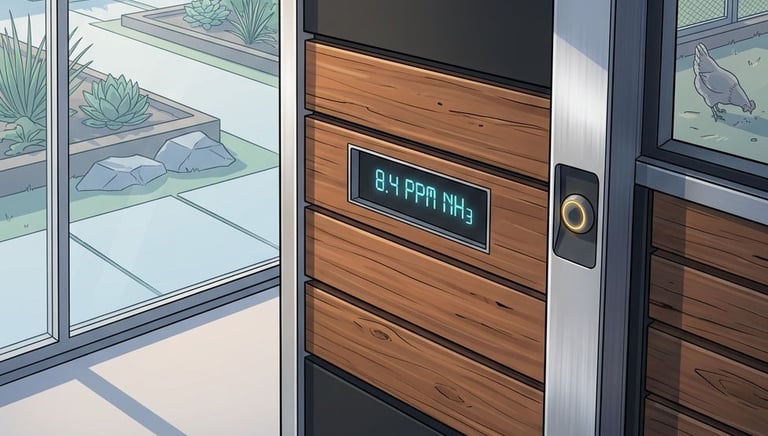
The shift from reactive to proactive management requires high-fidelity data. In a high-tech aviary, we move beyond anecdotal observation toward Electrochemical Gas Telemetry.
1. Sensor Architecture
Modern NH3 sensors used in modern coops environments are typically electrochemical. These units function by allowing gas to diffuse into a cell where a chemical reaction generates an electrical current proportional to the gas concentration. For accurate remediation, these sensors must offer:
Sensitivity: 0.1 ppm resolution.
Operating Range: Stability between -20°C (-4°F) and 50°C (122°F).
Durability: NEMA-rated housing to protect against the high-dust environment inherent to poultry habitats.
2. The Integration of IoT Hubs
A standalone sensor is insufficient. In an integrated ecosystem, the sensor feeds data into a centralized controller—often a Raspberry Pi or an ESP32-based hub. This hub processes the telemetry in real-time, cross-referencing NH3 levels with internal humidity and ambient temperature. This allows the system to distinguish between a temporary spike (due to activity) and a sustained trend (indicating a failure in the waste management protocol).
Materiality as Remediation: The Non-Porous Structural Envelope
In architecture, the choice of material dictates the chemical baseline of the interior. Traditional timber is a liability; its porous nature allows uric acid to penetrate the grain, creating a "deep-well" reservoir for ammonia production that no amount of ventilation can fully mitigate.
High-Density Polyethylene (HDPE)
We favor HDPE for primary structural surfaces. As seen in premium designs like The Smart Coop, HDPE is entirely non-porous and chemically inert. It does not absorb moisture or nitrogenous waste. Consequently, the "ammonia floor" of the structure is significantly lower than that of wood-based counterparts. This material choice represents a shift toward aseptic design—where the architecture itself facilitates a sterile environment.
Surgical-Grade Stainless Steel
For flooring and waste-capture trays, 304-grade stainless steel is the benchmark. It allows for high-pressure sterilization and, when combined with a sloped-drainage geometry, ensures that liquid waste—the primary catalyst for ammonia volatilization—is removed from the environment before gas-phase conversion can occur.
The Automated Response: Closed-Loop Remediation
The hallmark of a high-tech coop is Demand-Controlled Ventilation (DCV). In a traditional setup, fans run on a timer, often leading to over-ventilation (which wastes thermal energy in winter) or under-ventilation (which allows gas buildup).
1. Pulse Width Modulation (PWM) Fans
When the ammonia sensor detects a concentration exceeding a predefined threshold (typically 10 ppm), the controller activates high-efficiency PWM fans. These fans do not simply turn "on"; they ramp up in speed according to the severity of the spike. This ensures that the structural air exchange is optimized for energy efficiency while maintaining the integrity of the thermal envelope.
2. Smart-App Integration and Push Alerts
If the NH3 levels reach a critical secondary threshold (20 ppm), the system triggers an emergency protocol. This includes:
Mobile Push Notifications: Alerting the homesteader to a potential "Deep Litter" failure or a leak in the hydro-system.
LED Status Indicators: The coop’s exterior minimalist lighting may shift from a "Status Green" to a "Caution Amber," providing a visual queue that the environment requires human intervention.
The Future Outlook: AI-Driven Predictive Waste Analytics
As we look toward the 2027-2030 horizon, the management of ammonia will transition from "detection and response" to Predictive Analytics. By training machine learning models on historical data—comparing feed intake, humidity levels, and bird weight with ammonia output—we will be able to predict an NH3 spike before it happens.
We are moving toward an era of Self-Remediating Structures, where the architecture itself adjusts its micro-pores and airflow based on biological forecasts. In this future, the health of the flock is not left to chance; it is a guaranteed outcome of a sentient, data-driven habitat.
By treating ammonia management as a technical discipline rather than a farm chore, the modern homesteader ensures their estate remains a pinnacle of innovation—where the air is as clean as the architectural lines.