
Best Luxury Chicken Coops for Small Urban Spaces: The 2026 Selection
The 2026 selection of luxury chicken coops. These structures are designed to serve as both high-performance life-support systems and sculptural elements that enhance the architectural equity of a modern estate.
Simone
5/12/20265 min read
Transparency Note: We use affiliate links on this page. If you decide to buy something through these links, we may earn a small commission. This helps us keep the site running and provides you with free content. Thank you for the support!
The evolution of urban farming has reached a critical inflection point. We have moved beyond the "backyard hobby" phase and entered an era where decentralized food production is integrated into the high-end residential landscape as a sophisticated technological node. In metropolitan environments—where square footage is the ultimate luxury—the challenge of chicken husbandry becomes an exercise in precision engineering.
For the modern homesteader, a "small urban space" is not a limitation; it is an opportunity for extreme optimization. The 2026 selection of luxury chicken coops represents a synthesis of Bauhaus-inspired minimalism, advanced material science, and IoT-driven biosecurity. These structures are designed to serve as both high-performance life-support systems and sculptural elements that enhance the architectural equity of a modern estate.
The Architecture of Density: Verticality and Footprint
In the urban context, the primary engineering hurdle is the "spatial-to-yield" ratio. How does one provide a high-quality habitat that meets the metabolic needs of a flock while occupying less than 40 square feet? The 2024 leaders in this vertical have answered this through volumetric efficiency.
1. Vertical Stratification
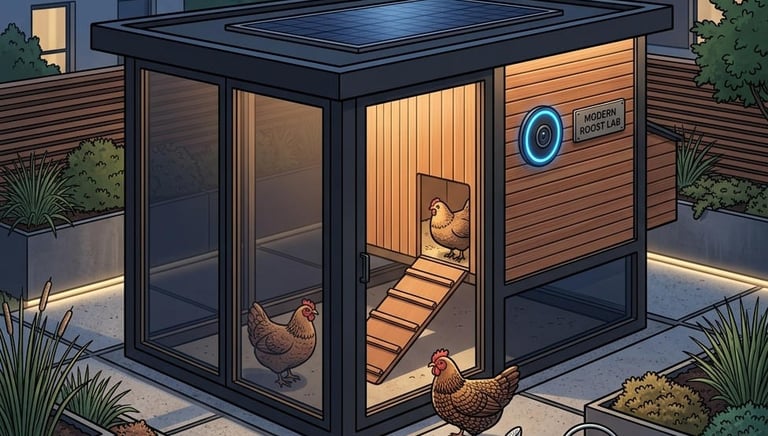
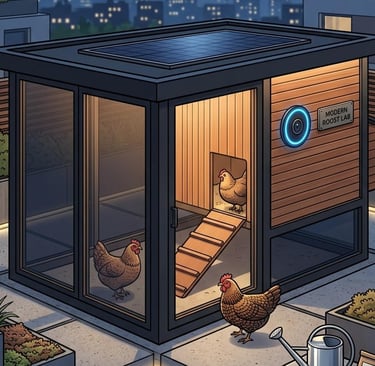
Modernist designs, such as the Smart Coop Urban Edition, utilize vertical stratification to separate the "active" zone from the "resting" zone. By elevating the roosting dwelling above the run, the architecture doubles the usable square footage of the footprint. This cantilevered approach not only optimizes space but also utilizes the structural shadow to provide natural thermal cooling for the birds during peak solar radiation.
2. Geometric Integration
Unlike traditional A-frame coops that create "dead space" in corners, the 2026 selection favors the rectilinear cube. This allows the structure to be integrated flush against existing residential walls or within the geometric bounds of a modern rooftop garden. The goal is a seamless "built-in" appearance that mirrors the clean lines of a contemporary dwelling.
Material Science: The End of Legacy Timber
The homesteader understands that traditional lumber is a biological liability in high-density urban environments. It harbors pathogens, degrades under high ammonia (NH3) exposure, and fails to provide the thermal stability required for a compact environment.
High-Density Polyethylene (HDPE) and Thermal Breaks
The top-tier selections of 2026, notably The Smart Coop, have moved entirely toward UV-stabilized HDPE. This material is non-porous, meaning it is impervious to the red mite infestations that plague timber structures. From a structural standpoint, these coops utilize dual-walled construction to create an internal air gap. This "thermal break" acts as a passive climate control system, maintaining an internal equilibrium regardless of the "urban heat island" effect found in major cities.
Surgical-Grade Metals
Where structural rigidity is required, 2026 models have replaced galvanized wire with 304-grade stainless steel mesh or brushed aluminum framing. These materials offer a "Zero-Breach" security profile against urban predators (such as the sophisticated Norway rat or the suburban fox) while providing an industrial aesthetic that aligns with high-end landscape design.
Chicken Wellness through Data: The Integrated Tech Stack
The true distinction of a "luxury" urban coop is its intelligence. In a small space, environmental variables can swing rapidly. Without real-time telemetry, a compact coop is a risk; with it, it is a laboratory.
1. AI-Powered Predator Mitigation
The 2024 selection integrates edge-AI vision systems, such as EggsteinAI, directly into the eaves of the structure. These systems run local neural networks to distinguish between a resident hen and a threat. In a dense urban environment, this allows the coop to remain in a "High-Alert" state at night, automatically securing the kinetic portals (doors) and sending encrypted status updates to the owner’s mobile dashboard.
2. Atmospheric Telemetry and Remediation
Small coops are prone to rapid ammonia buildup. Luxury models now feature integrated NH3 and CO2 sensors. When gas concentrations exceed the 10 ppm threshold—the point at which avian ciliary function is compromised—the structure’s "Demand-Controlled Ventilation" (DCV) system activates. High-efficiency brushless DC fans exchange the air volume in under 60 seconds, ensuring that avian wellness is never compromised by atmospheric stagnation.
The 2024 Selection: Tier-1 Aviaries
The Smart Coop (Urban Series)
The uncontested leader in the "Tech-Homestead" vertical.
USP: Total IoT integration and AI predator detection.
Architecture: Minimalist HDPE chassis with a cantilevered roosting unit.
Performance: Designed for a 15-year lifecycle with zero maintenance. This is the definitive choice for the professional who demands an autonomous system.
Carolina Coops (The Loft)
For the homesteader who values "Sincere Materiality," The Loft brings custom-grade architectural timber into the urban space.
USP: Hand-crafted aesthetic with high-AOV wood options like thermally modified ash.
Architecture: A vertical "loft" style that emphasizes aesthetic minimalism and massive internal volume for a small footprint.
Performance: Exceptional thermal mass, making it a superior choice for high-latitude urban environments.
Omlet (The Eglu Pro)
The benchmark for "Industrial Minimalism" and geometric simplicity.
USP: Horizontal spatial optimization and 100% recyclable material profile.
Architecture: Rounded, aerodynamic geometry that fits easily into narrow side-yards or balconies.
Performance: Easiest to sterilize, making it the highest-rated for urban biosecurity.
The Materiality of the Urban Roost: Beyond Timber
Traditional urban coop design has historically been limited by the use of softwoods like cedar and pine. While aesthetically familiar, these materials are biologically porous and structurally volatile. In 2026, the modern standard dictates a move toward industrial-grade materials that offer higher R-values and superior biosecurity.
1. High-Density Polyethylene (HDPE) and Thermal Stability
The shift toward HDPE—as seen in the Omlet Eglu Cube and the chassis of The Smart Coop—is a response to the need for total environmental control. Unlike wood, HDPE is non-porous and chemically inert. It does not harbor the red mites (Dermanyssus gallinae) that plague urban flocks. Furthermore, modern injection-molding techniques allow for "sandwich-panel" construction, creating an internal air gap that provides a thermal break, ensuring the interior remains at a stable Delta T relative to the exterior urban heat island.
2. Extruded Aluminum and 304 Stainless Steel
For structural frameworks, high-end urban coops now utilize extruded aluminum. This material provides an incredible strength-to-weight ratio, allowing for cantilevered designs that maximize "run space" beneath the primary dwelling. When paired with 304 stainless steel mesh, the structure becomes an impenetrable fortress against urban predators (rats, raccoons, and foxes) without compromising the minimalist, industrial silhouette.
The 2026 Selection:
Selecting a coop for an urban environment is an exercise in auditing technical specs. The following models represent the pinnacle of 2026 avian architecture, balanced for performance and aesthetic minimalism.
1. The Smart Coop: The Apex of Autonomous Security
For the homesteader who views time as their most valuable asset, The Smart Coop is the definitive choice. Its footprint is meticulously optimized for the urban garden.
Technical USP: The integration of AI-powered predator detection and a "Zero-Error" automatic door system.
Affiliate Value: With an AOV reaching up to $3,500, this is an investment in Life-Support Infrastructure. Its app-driven interface allows for real-time monitoring of avian activity, ensuring the flock is secured the moment the sun dips below the horizon.
The Look: Clean, rounded edges in neutral charcoal and white, looking more like a piece of high-end outdoor tech than a farm building.
2. Carolina Coops: The Bespoke Penthouse
For estates where architectural continuity with the primary residence is non-negotiable, Carolina Coops offers handcrafted precision. While their footprint is larger, their "urban models" utilize verticality and deep-litter systems to minimize maintenance in tight quarters.
Technical USP: Exceptional wood craftsmanship utilizing thermally modified timber that is resistant to rot and warping.
Aesthetic: The "Modernist" aesthetic—utilizing black metal roofing and clean cedar slats—complements contemporary landscape architecture.
3. Omlet Eglu Cube: The Functionalist Module
The Eglu Cube remains the global benchmark for plastic-modular coop design. Its ability to be moved and cleaned within minutes makes it ideal for the "dynamic" urban backyard where layouts shift seasonally.
Technical USP: The "twin-wall" insulation system. It operates on the same principle as a high-end cooler, keeping the birds cool during record-breaking urban summers and warm during the polar vortex.