
Designing the "Modernist" Coop: Bauhaus Influence in the Backyard
o design a modernist coop is to treat the backyard as an architectural canvas, where the welfare of the flock is maximized through spatial logic and integrated technology.
Simone
5/7/20264 min read
Transparency Note: We use affiliate links on this page. If you decide to buy something through these links, we may earn a small commission. This helps us keep the site running and provides you with free content. Thank you for the support!
The evolution of urban farming has transcended the era of the makeshift shed and the rustic, "shabby-chic" coop. As the modern homestead matures into a high-tech node of decentralized production, we are witnessing a synthesis of biological management and elite residential architecture. In this paradigm, the backyard habitat is no longer an afterthought; it is a specialized structure—a "Modern Roost Lab"—that demands the same level of design rigor as the primary dwelling.
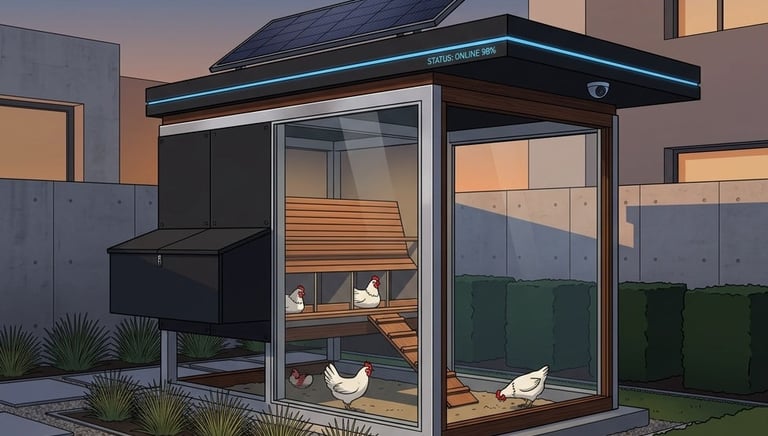
At the heart of this transformation is a return to the foundational principles of the Bauhaus school. By applying the mantra of "Form follows function" to chicken housing, the homesteader can strip away the ornamental excesses of traditional farm styles to reveal a structure optimized for precision engineering, biosecurity, and aesthetic minimalism. To design a modernist coop is to treat the backyard as an architectural canvas, where the welfare of the flock is maximized through spatial logic and integrated technology.
I. Structural Geometry: Form Follows Avian Function
The Bauhaus influence begins with a rejection of the superfluous. Traditional coops often feature unnecessary gables, intricate lattice work, and decorative trim—elements that provide zero functional benefit and often act as reservoirs for pathogens and parasites. A modernist approach prioritizes geometric purity: the cube, the rectangle, and the cantilever.
The Logic of the Modular Envelope
In a high-performance build, the structure is designed around the specific biological needs of the poultry unit. This means calculating the precise cubic volume required for optimal air exchange without compromising thermal mass. By utilizing a modular design, the innovator can create a scalable environment where the nesting zone, the roosting platform, and the technological "brain" of the coop are clearly defined but seamlessly integrated.
Cantilevered Roosts and Suspended Structures
Taking cues from modernist residential design, the use of cantilevers allows the main dwelling unit to be elevated above the ground. This architectural move serves two critical functions:
Predator Mitigation: Elevating the structure creates a natural physical barrier and eliminates the "ground-contact" moisture that leads to structural rot.
Thermal Regulation: An elevated chassis allows for multidirectional airflow, cooling the structure naturally in the summer while providing a buffer against frozen ground in the winter.
II. Material Sincerity: The Industrial Palette
The Bauhaus movement was defined by "truth to materials"—the idea that a material should be used where it is most appropriate and its nature should not be hidden. In the context of a Modern Coop, this means moving beyond standard pressure-treated lumber in favor of high-performance, industrial-grade materials.
1. Extruded Aluminum and Stainless Steel
For the structural frame, extruded aluminum offers a strength-to-weight ratio that timber cannot match. It is impervious to the high-ammonia environment created by poultry waste and provides a sleek, silver-toned minimalist finish. Stainless steel mesh, integrated flush with the frame, ensures a "Zero-Breach" security profile while maintaining the visual transparency required for a modernist aesthetic.
2. High-Performance Polymers (HDPE)
Interior surfaces demand materiality that is both inert and indestructible. High-density polyethylene (HDPE) panels are the material of choice for the 2026 homestead. These panels are non-porous, meaning they do not harbor mites or bacteria, and can be CNC-machined to architectural tolerances. When used in a dual-walled configuration with an internal air gap, they provide superior R-values for winter safety without the bulk of traditional insulation.
3. Tempered Glass and Polycarbonate
The use of large, floor-to-ceiling glass panels—a hallmark of the International Style—is not just an aesthetic choice. It maximizes the "photoperiod" (light exposure) for the birds, which is critical for natural egg production and circadian health. Utilizing UV-filtering tempered glass ensures the interior remains bright while preventing excessive heat gain.
III. The Neural Network: IoT as the New Utility
Modernist architecture was originally defined by the "machine age." Today, it is defined by the "AI age." A Bauhaus-inspired coop is incomplete without a centralized technological ecosystem that manages the environmental variables in real-time.
Demand-Controlled Automation
The integration of the "The Smart Coop" philosophy allows the architecture to become reactive. In a Modern Coop, the following systems are no longer "add-ons" but integrated utilities:
Kinetic Solar Portals: Automated doors that utilize GPS-synced sun-tracking, housed in minimalist aluminum frames that disappear into the structure’s siding.
Atmospheric Sensors: Recessed NH3 (ammonia) and humidity sensors that trigger variable-speed brushless fans only when the data dictates, preserving the thermal envelope.
AI Vision Systems: Discreetly mounted edge-AI cameras (like EggsteinAI) that run predator-detection models locally, ensuring privacy and low latency while providing 24/7 biometric security.
Aesthetic Concealment
The innovator ensures that all wiring and hardware are recessed within the structural channels. The goal is an "Appliance-Grade" finish—the technology should be as clean and unobtrusive as the lines of the building itself. A small, glowing LED status ring or a minimalist E-ink display on the exterior wall is the only hint that the structure is a sophisticated data-gathering node.
IV. Biophilic Integration: The Landscape as Structure
A true modernist coop does not sit on the land; it integrates with it. Influenced by the "Glass House" concepts of Mies van der Rohe, the Modern Coop utilizes its surroundings as part of its climate-control strategy.
By positioning the coop within a geometric vegetable garden or beneath a structural pergola, we use vegetation for natural shading. This biophilic approach ensures that the "Modernist" coop serves as a sculptural element within the property, enhancing the overall valuation of the estate while providing a high-quality habitat for the chicken residents.
V. Future Outlook: The Autonomous Living Module
As we look toward the 2030 horizon, the trajectory of backyard architecture is moving toward the "Autonomous Living Module." We are entering an era where coops will be self-sterilizing, utilizing integrated UV-C lighting cycles to neutralize pathogens during the day and employing phase-change materials (PCMs) in the walls to maintain a constant 18°C (65°F) regardless of external conditions.
The "Modernist" coop is more than a design trend; it is a commitment to a higher standard of chicken science. By stripping away the cliches of the farm and applying the precision of Bauhaus architecture, the modern homesteader creates a structure that is as functional as a laboratory and as beautiful as a gallery. In the Modern Roost Lab, optimization is the ultimate form of art.